I've just found this interesting question on StackExchange:
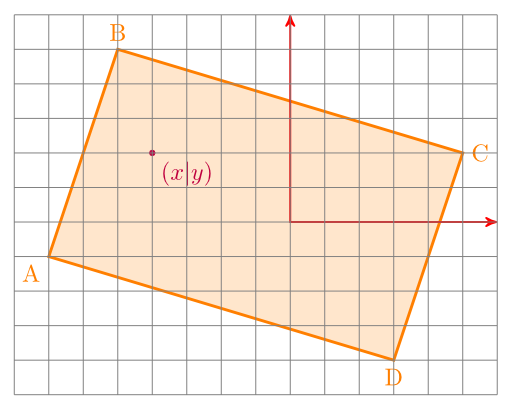
If you have a rectangle ABCD and point P. Is P inside ABCD?
The idea
The idea how to solve this problem is simply beautiful.
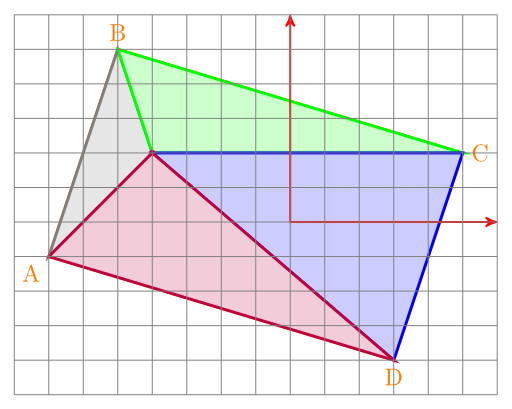
If the point is in the rectangle, it divides it into four triangles:
If P is not inside of ABCD, you end up with somethink like this:
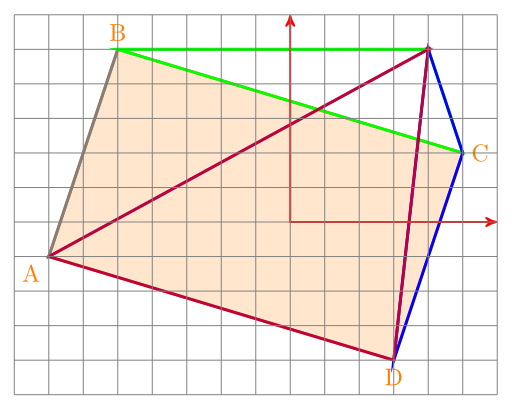
You might note that the area of the four triangles in is bigger than the area of the rectangle. So if the area is bigger, you know that the point is outside of the rectangle.
Formulae
If you know the coordinates of the points, you can calculate the area of the rectangle like this:
\(A_\text{rectangle} = \frac{1}{2} \left| (y_{A}-y_{C})\cdot(x_{D}-x_{B}) + (y_{B}-y_{D})\cdot(x_{A}-x_{C})\right|\)
The area of a triangle is: \(A_\text{triangle} = \frac{1}{2} (x_1(y_2-y_3) + x_2(y_3-y_1) + x_3(y_1-y_2))\)
Python
from typing import Tuple
from dataclasses import dataclass


@dataclass
class Point:
    x: float
    y: float


Rectangle = Tuple[Point, Point, Point, Point]


def is_p_in_rectangle(r: Rectangle, P: Point) -> bool:
    area_rectangle = 0.5 * abs(
        #   y_A      y_C      x_D      x_B
        (r[0].y - r[2].y) * (r[3].x - r[1].x)
        #    y_B     y_D       x_A     x_C
        + (r[1].y - r[3].y) * (r[0].x - r[2].x)
    )

    ABP = 0.5 * (
        r[0].x * (r[1].y - r[2].y)
        + r[1].x * (r[2].y - r[0].y)
        + r[2].x * (r[0].y - r[1].y)
    )
    BCP = 0.5 * (
        r[1].x * (r[2].y - r[3].y)
        + r[2].x * (r[3].y - r[1].y)
        + r[3].x * (r[1].y - r[2].y)
    )
    CDP = 0.5 * (
        r[2].x * (r[3].y - r[0].y)
        + r[3].x * (r[0].y - r[2].y)
        + r[0].x * (r[2].y - r[3].y)
    )
    DAP = 0.5 * (
        r[3].x * (r[0].y - r[1].y)
        + r[0].x * (r[1].y - r[3].y)
        + r[1].x * (r[3].y - r[0].y)
    )
    return area_rectangle == (ABP + BCP + CDP + DAP)
Triangle
The same idea can easily be adopted to triangles:
from dataclasses import dataclass


@dataclass
class Point:
    x: float
    y: float


class Triangle:
    """Represents a triangle in R^2."""

    epsilon = 0.001

    def __init__(self, a: Point, b: Point, c: Point):
        self.a = a
        self.b = b
        self.c = c

    def get_area(self) -> float:
        """Get area of this triangle.
           >>> Triangle(Point(0.,0.), Point(10.,0.), Point(10.,10.)).get_area()
           50.0
           >>> Triangle(Point(-10.,0.), Point(10.,0.), Point(10.,10.)).get_area()
           100.0
        """
        a, b, c = self.a, self.b, self.c
        return abs(a.x * (b.y - c.y) + b.x * (c.y - a.y) + c.x * (a.y - b.y)) / 2

    def is_inside(self, p: Point) -> bool:
        """Check if p is inside this triangle."""
        current_area = self.get_area()
        pab = Triangle(p, self.a, self.b)
        pac = Triangle(p, self.a, self.c)
        pbc = Triangle(p, self.b, self.c)
        new_area = pab.get_area() + pac.get_area() + pbc.get_area()
        return abs(current_area - new_area) < Triangle.epsilon


if __name__ == "__main__":
    import doctest

    doctest.testmod()
Credits
Thank you Teon Brooks for reporting an error (I wrote "rectangles" instead of "triangles")