Having machines that can write software is the dream of probably every company. Instead of having years of development, you just tell the machine what to do and it automatically creates the software.
As you might have guessed, we are not there yet. Not even close. But a friend of mine made me think about this problem. Being a software engineer, I tried to split up the problem into smaller chunks that might be in reach.
Before we dive into those sub-problems, let me roughly describe how developing big software works.
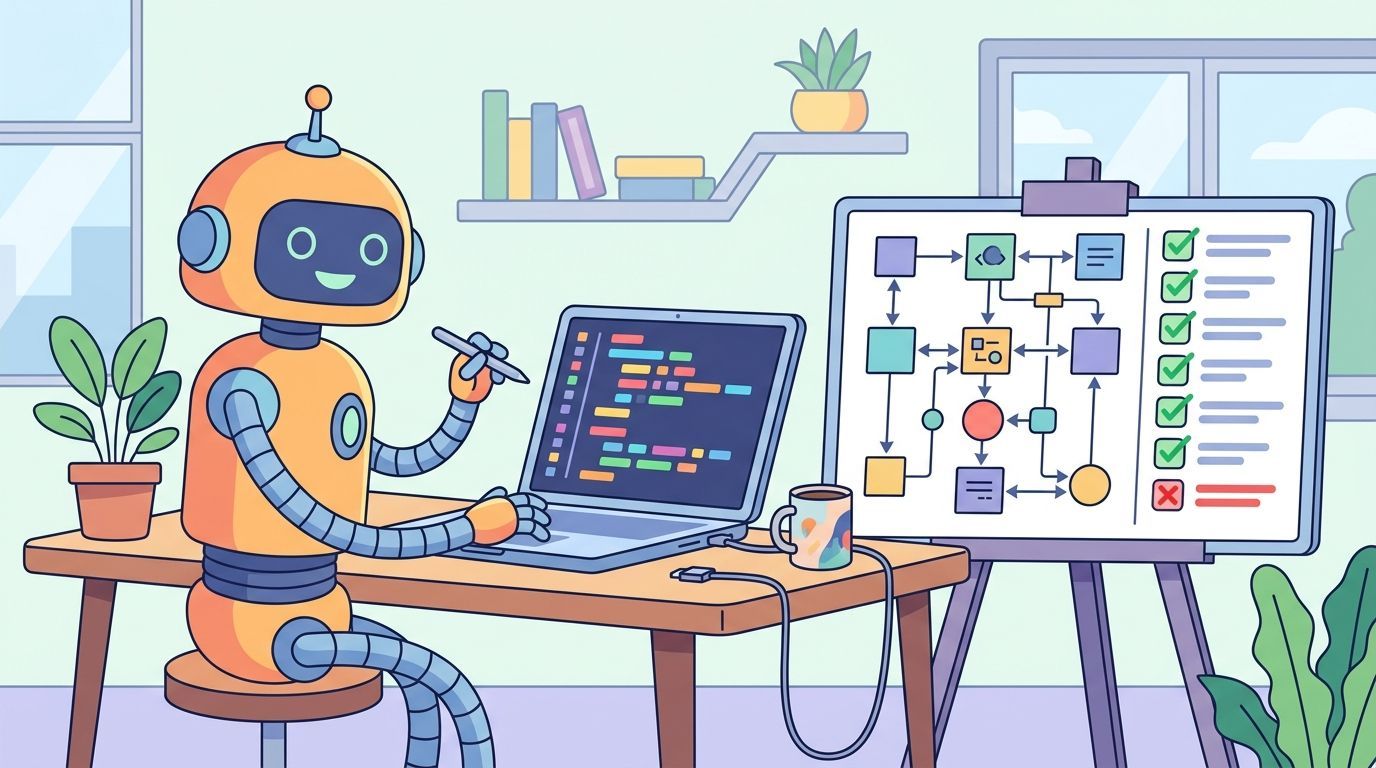
Software Engineering 101
You have an idea. Let's take one of the projects I never realized: A book portal.
We have a name for it, that's good. Book portal. But now we need to get some details. One tool for that are user stories:
As a science fiction book enthusiast, I would like to find more books I love. I am willing to note a couple of other books I loved, give some general restrictions like the language, minimum and maximum length and price range. Then I expect some recommendations.
Awesome, now we get a rough idea! So it actually is not a store, but a recommendation engine!
But non-functional requirements often play a crucial role. Realizing this project means you have to make sure you know what you want:
- How many books should be recommendable?
- How fast should the user be able to add new books?
- How much time does the recommender have between adding ratings for books and spitting out a recommendation?
- What is the minimum quality the recommendation engine needs to be useful?
- How many users are expected at peak times within 15 minutes?
- Is privacy a concern? What are we legally obliged to do?
Once those questions are answered (especially the load-based ones), you can draw an architecture. This means you try to find components that can be developed largely independently. You have to define interfaces, i.e. how those components are supposed to communicate.
After the architecture, you develop the defined components.
Congratulations, you have an alpha version! Now you can go through the other stages of Software Development.
Code Challenges
Many of the code challenges are hard because it's not clear how to evaluate the solutions. There are many possible (acceptable) solutions, but there is no way to enumerate all of them.
Architecture Generation Problem
Given a document describing the idea, user stories and non-functional requirements, generate an architecture diagram.
I'm not sure how hard this is. It certainly is super hard to evaluate how good the solution is.
Equivalence Problem
Given two functions with the same signatures, are they equivalent?
- Why it's hard: Equivalence cannot be proven in general (it's undecidable); hard to construct non-trivial cases
- What's good about it: Non-equivalence can be proven with one counter-example
- Usefulness: 2/5
Auto-Doc Problem
Given a function, write the documentation of it.
- Why it's hard: Many equivalent solutions
- What's good about it: Getting training data might be easy
- Usefulness: 5/5
Code-Generation Problem
Given a formal specification, generate code.
- Why it's hard: I'm not sure about the formal specification - what exactly would they look like?
- Usefulness: 3/5
The reason why I think this is not so useful is the specification. In the end, the most exact specification is a program. Hence, if you need a very formal, exact specification, there is actually no code to generate. When the specification is imprecise (like natural language), then there is (too much) room for error.
Code-Translation Problem
Given code in language A, translate it to equivalent code in language B.
- Why it's hard: Some things might not be possible at all. This would likely be the case when you translate C to Python.
- Usefulness: 5/5
The reason why this is super useful are apps. Imagine if you only had to develop an app for Android and could automatically translate it to iOS. (By the way: Is that possible with React Native?)
The key challenge here is to make the translated code maintainable. In some sense, you could say that the Auto-doc problem is part of this challenge.
Code-Style translation Problem
Code-Style translation Problem is a subtask of the more general Code-Translation Problem. Imagine a Java developer writing (correct) Python code. Things you might see:
- OverlyLongVariableNamesLikeGermanWords
- Too many classes / subclasses where you could simply use
collections.namedtuple/ functions. - Missing use of syntactic sugar such as
enumerate,zip, list comprehensions
Refactoring Problem
Given code, generate code with the same functionality which is (a) easier to maintain (b) faster / more memory efficient (c) applicable to more cases.