I've recently had a very interesting discussion with some friends. We talked about a lot of stuff and I don't want to go into detail about the topics we've discussed, but rather share some thoughts about discussions.
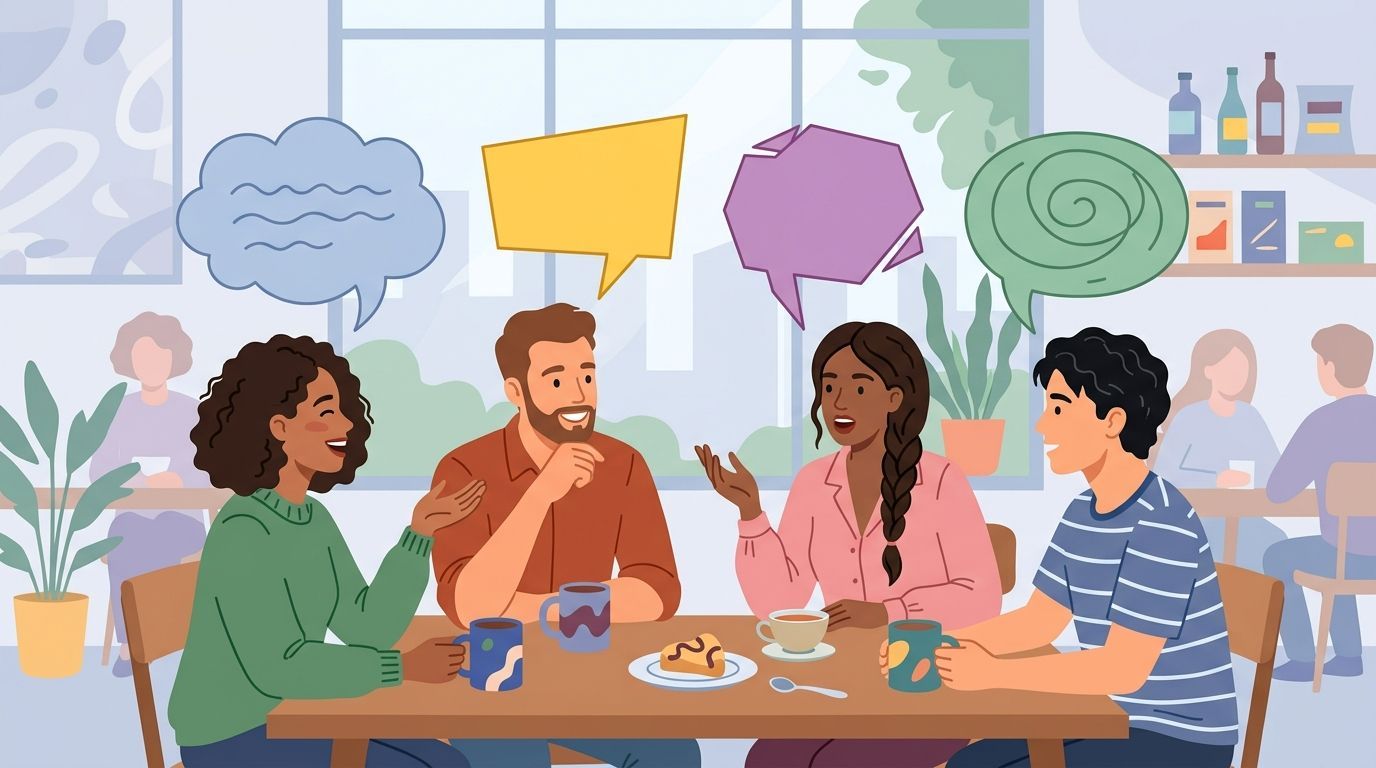
Types of discussions
There are many ways people talk to each other:
- Small Talk is about being together and feeling fine. We do it when we are together waiting for something or just because it feels good. It's not so much about content, as talks about the weather, fashion or sitcoms show, although the amount of information you exchange varies quite a lot.
- Feelings and talking about feelings is difficult, but important. I tend to say it's like small talk, but I don't want to go into detail here.
- Teaching is a situation where one person knows more than another person about some topic and teaches it to the other.
- Learning is either the other side in the teaching situation or learning together. I think it is fundamentally different and deserves its own bullet point because in the teaching situation, the teacher leads the conversation. In the learning situation you don't have somebody who leads the conversation. It's a free flow of (hopefully) constructive thoughts with the aim of gaining a new ability as a group.
- Moral or Political Discussions are some sort of learning, but in contrast to learning in the sense that you get another ability or get to know some more facts, the aim is to evaluate how to weigh those facts. Discussions involve a learning part, but the core is about putting things together. So it is not mainly about what could be done but what should be done and for what reasons.
What's special about discussions?
Discussions involve some aim. That aim might be
- What is the best way to explain XYZ? What does best mean in this context?
- What should we do in situation ABC? What has to be considered and for what reasons?
But many of the conversations that are labeled as "discussions" feel rather like small talk for the following reasons:
I think to have a meaningful discussion, you need to have a partner who does not share your opinion. For political discussions, this means the following are NOT meaningful statements:
- I want everybody to be able to find a job (or shorter: Fight unemployment)
- I want to make less debt
- I want everybody to be able to live a healthy life
- I want to help families
- I want everybody to be happy
All these statements are statements that everybody could agree with. But you get reasonable statements when you tell how to do so.
You can also talk about the "order": I want to make less debt, but if young families have to pay more than 20 Euro more per year, it is not acceptable. Of course, that's still much too vague, but I think you get the point. Telling what you value might help people to intuitively decide with which person they could rather identify, but it is not enough to name reasons.
Another important part of a meaningful discussion is that it should in theory be possible to change the mind of the other person. This is the reason why I've called it "discussions with friends". In contrast to the truth-finding "discussions" you have in science, you don't need to be able to say what observations could falsify your theory. But if you go into a discussion and you know that it is impossible that the other - no matter how well he makes his point - convinces you of his opinion, you're actually not having a discussion. You try to teach them. (And it's a bad type of teaching.)
Techniques to get the most out of discussions
It is difficult to be open-minded in a good discussion. You might need to end
a discussion and think through it some time after you had it. Because we tend
to defend a point of view when we begin to defend it, no matter how well the other
makes his point. It is very difficult to honestly say: Yes, you're correct. That
changes the case and probably my opinion.
And you should not say so too fast. Some people are charismatic, some can speak
or write very well. When you hear a new argument the first time, you might have
difficulties finding a correct counterargument. But when you're with friends,
you should be able to say:
That's the first time I've heard that. I have to think about it.
or something like
I've never seen it from that perspective.
People like to teach and this makes them feel more comfortable discussing with you. You don't give up your opinion with statements like these, but it's simply being honest.
Speaking of honesty, there is a similar DON'T: Don't say something like
Yes, I agree with you, but [Whatever he just said negated]
I hear this so often in political debates by amateurs who have read something about discussions. By agreeing you make it easier for your discussion partner to agree with you (he can't disagree when you agree with him, can he?), but it should be an honest way to agree. It's a very bad step to fake agreement.
Group dynamics
Always - and that's not only related to discussions - try to think what and how the other thinks. Sometimes when a group discusses, a single person gets isolated and has to defend his point of view alone. That's ok. But don't make it worse for him:
- Give him enough time to think and to talk.
- Only one person and argument at a time. It's difficult to switch and to concentrate on two (or even more) separate discussions.
- Try to support him when he has trouble finding the correct words or the best way to express himself. It is difficult to tell when you simply have to wait and give him some time to think and when you should try to support him.
Know when you're wrong
Changing opinions is difficult. Especially if you have had them for a long time or when you've already defended them. It's a little bit like an investment. When you've already spent 6,000 Euro on an investment and there is a tiny chance that you will get what you want but a growing chance that the investment was just a bad idea and probability suggests changing the investment and rescuing what's left, most people will not do so. Somehow we quite often tend towards all-or-nothing thinking which is suboptimal in many cases.
So, what can we do to figure that out for ourselves? Sometimes it is impossible to do so while discussing, but after the discussion you can think about it:
- What arguments did I give the others? How did I present them? What were the counterarguments? Are they valid? If so / not: Why?
- Are there arguments I've missed?
- Do I feel comfortable with my arguments? Why do I think they could be weak? What do I think are strong arguments? Do others also think that those arguments are strong?
If you're not sure about it, you can continue the discussion. It should not be a simple repetition of arguments, but a new discussion with a new structure of arguments. If you're still not sure after many arguments, you can make a pro / con list.
Please note:
- It's not important what the majority thinks. However, it might be an indicator.
- Some arguments might simply be wrong. But don't make this choice too easily.
- Some arguments might be irrelevant. I tend to think "How does this impact my life?". If an argument has no impact or simply assumes an unrealistic situation, it might be irrelevant.
- You don't have to agree at the end. An honest disagreement where both sides understand the arguments of the other side is much better than a compromise that no side really thinks is good.
And I want to note that discussions might have many equally valid answers, whereas science has only one correct answer (which might be difficult to find / almost impossible to decide which thesis is correct, but there is only one).